
Mr. Christopher Layne met Romanian experts 23.08.2013
-
On August 23, 2013, the Institute for Political Studies for Defense and Military History organized a meeting with Mr. Christopher Layne, Robert M. Gates Chair Professor in Intelligence and National Security at the George W. Bush School of Government and Public Service, Texas A&M University.
-
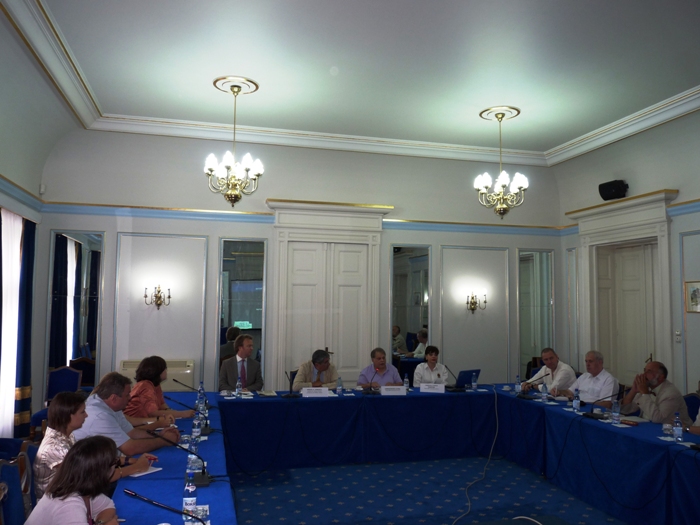
The scientific encounter was held in the National Military Club of Bucharest, in the sumptuous Mirrors’ Hall and the participants (around 25) comprised scientific researchers in security and history, doctoral students and employees of the Ministry of Defense, but also representatives of the civil society. Christopher Layne is a well-known American international relations theorist and an adept of the neorealist branch of IR, writing mainly on US foreign policy and grand strategy. Previously, he has taught political sciences and international relations at the University of California at Los Angeles, the Naval Postgraduate School, and the University of Miami.
-
The guest explained the fact that the US foreign policy is based on two kinds of variables: external and internal. Internally, Washington has been affected since 2008 by the huge world economic crisis and domestic fiscal crisis), while externally the rise of People’s Republic of China and other emerging powers implicitly diminish the size of the US aggregate power. The USA still enjoys a huge economic advantage, as the dollar is still the world reserve currency, trusted by most nations in the world. But the national economy experienced a decline in the last years. The budget deficit and the huge public debt forced the government to apply to sequester on all the field of activities based on public funds. Credible forecasts indicate that around the year 2030, China and India (but also other smaller powers) will dominate the world economy. USA had been the number one industrial power in the 20th century but now the fiscal crisis, the budgetary deficit and the des-industrialization are the factors which come along the shift of power towards Asia, a general trend since the end of Cold War. As the USA tried to keep their military supremacy after the Cold War and especially after September 2011, they invested too much in national defence.
-
Nowadays, the USA represents 18% of the global GDP but about 40% of the global military spending. The huge trade deficit and the risk of the US dollar losing its top position pushed the decision-makers in Washington to decide a massive cut in the military spending for the next ten years. The US dollar is the number one tool for maintaining the global supremacy as the US is economically less constrained than other states. But if the USA would lose the advantage to be able to print money and pay for their geopolitical power projection, they will not be able any more to keep China at distance.
-
China’s rise is, according to professor Layne, a restoration not a rise, after the period 1848-1948 called by Chinese “the century of humiliation.” Using some specific criteria like the power parity buying, China is already number one, but the USA still maintains a big distance in the per capita income and the technological area. Professor Layne dismisses the theories which pretend that China will fail starting with its artificially grown economy. In fact, Chinese economy and society are cautiously managed by the Communist Party elites. But the rising of China as a great power will generate geopolitical instability, because the powers aspiring to be hegemons first want to dominate their surrounding areas. It is not a good idea to accept Chinese pretended “peaceful rising” doctrine, since all emerging regional hegemons have similar goals and cannot avoid provoking regional turmoil. Between the US (dominant world power) and China (the main challenger) there is a triple rivalry: naval, resources and prestige/status one). The East Asia area has some potential conflicting issues: Taiwan, Korea, East and South China Seas. There is no possibility to manage a perfect accommodation between Washington and Beijing, as they have different vales and goals. Christopher Layne calls this situation “the Newtonian Theory of Geopolitics”. One cannot see a double hegemony in the same region.
-
The analogy with UK-Germany rivalry between 1880-1914 is feasible and the famous debate between British MFA analyst Eyra Crowe’s views on a nefarious Germany aspiring to world hegemony in a memorandum before WWI and lord Sanderson who insisted on the German legitimate rights to be accommodate, must be envisaged with care, as history is not repetitive but accepts some analogies. Worse than a world with two great powers competing for primacy is a world with no hegemon (dominant power) to manage the world system. Anyway, the countries which had been subject to western domination in the previous two centuries now “take their revenge” by rising and becoming regional powers and even world powers. The USA must not rely on a pure “graceful retrenchment” and let China become number one in the system but it must also avoid war, unless absolutely necessary for the national security.
-
The dissertation was followed by a Q&A session which allowed professor Layne to further clarify his opinions summarized above. The American guest valued the quality of the discussions with the Romanian experts.